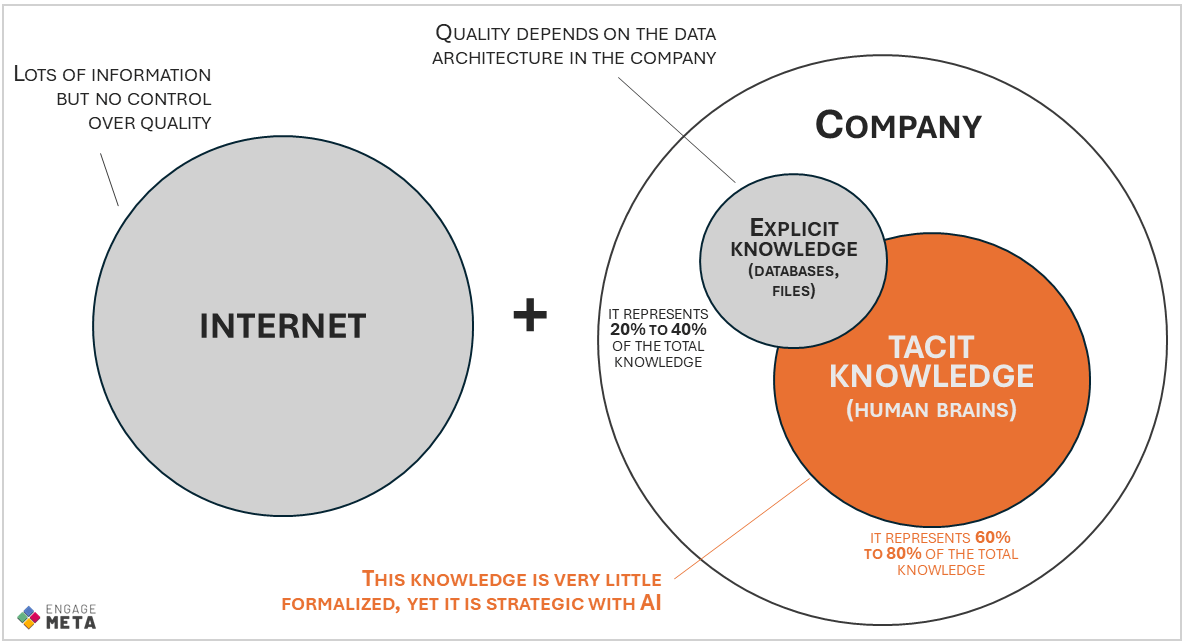
Most organizations lack a precise understanding of their own knowledge. Documentation is scattered across departments, databases capture only part of the information used in day-to-day operations, and employee turnover can result in the loss of valuable practices and experience. For AI systems, however, this enterprise knowledge is essential. Organizations must therefore improve the quality and governance of their existing data while also identifying, formalizing, and managing the relevant tacit knowledge held by their teams.
In many organizations, only an estimated 20% to 40% of enterprise knowledge is formalized in databases and documents. The remaining 60% to 80% resides largely in employees’ experience and know-how.
Yet this knowledge is essential for grounding AI systems in the realities of the business. Organizations should therefore establish programs to capture and formalize relevant tacit knowledge, while improving the quality and governance of their existing information assets. These capabilities are strategic to the success of Enterprise AI and to achieving the expected productivity gains.
Personal Knowledge
Every employee holds valuable explicit and tacit knowledge about the organization’s activities. Explicit knowledge can be documented and shared, while tacit knowledge comes from experience, judgment, and practical know-how. Knowledge management helps individuals capture, organize, update, and share the relevant parts of this knowledge. This protects the organization from knowledge loss when employees leave and makes expertise available beyond a single person or team. It also gives AI systems reliable business context, allowing them to support employees more effectively while preserving the essential role of human expertise.
Collective Knowledge
Collective knowledge emerges when the knowledge held by individuals is shared and combined across teams and departments. It includes documented information as well as experience, practices, and lessons learned from daily work. When this knowledge remains fragmented or trapped in employees’ minds, the organization loses opportunities to improve, innovate, and adapt. A collective knowledge approach makes relevant expertise accessible across the organization. AI can support this process by helping capture, structure, connect, and retrieve knowledge, while governance ensures that the resulting information remains accurate, current, and trustworthy.
Enterprise Architecture
Enterprise Architecture provides the structures needed to organize knowledge at scale. It connects business concepts, processes, data, applications, rules, and responsibilities within a coherent enterprise view. This shared foundation helps teams understand how their knowledge relates to the wider organization and supports consistent decisions across departments. It also enables AI systems to access the right governed knowledge for each business purpose, instead of relying on scattered documents or isolated data. Combined with a culture of knowledge sharing, Enterprise Architecture helps organizations deploy AI that remains aligned with business needs and human expertise.
The WASI Effect: Human Capabilities for Better AI
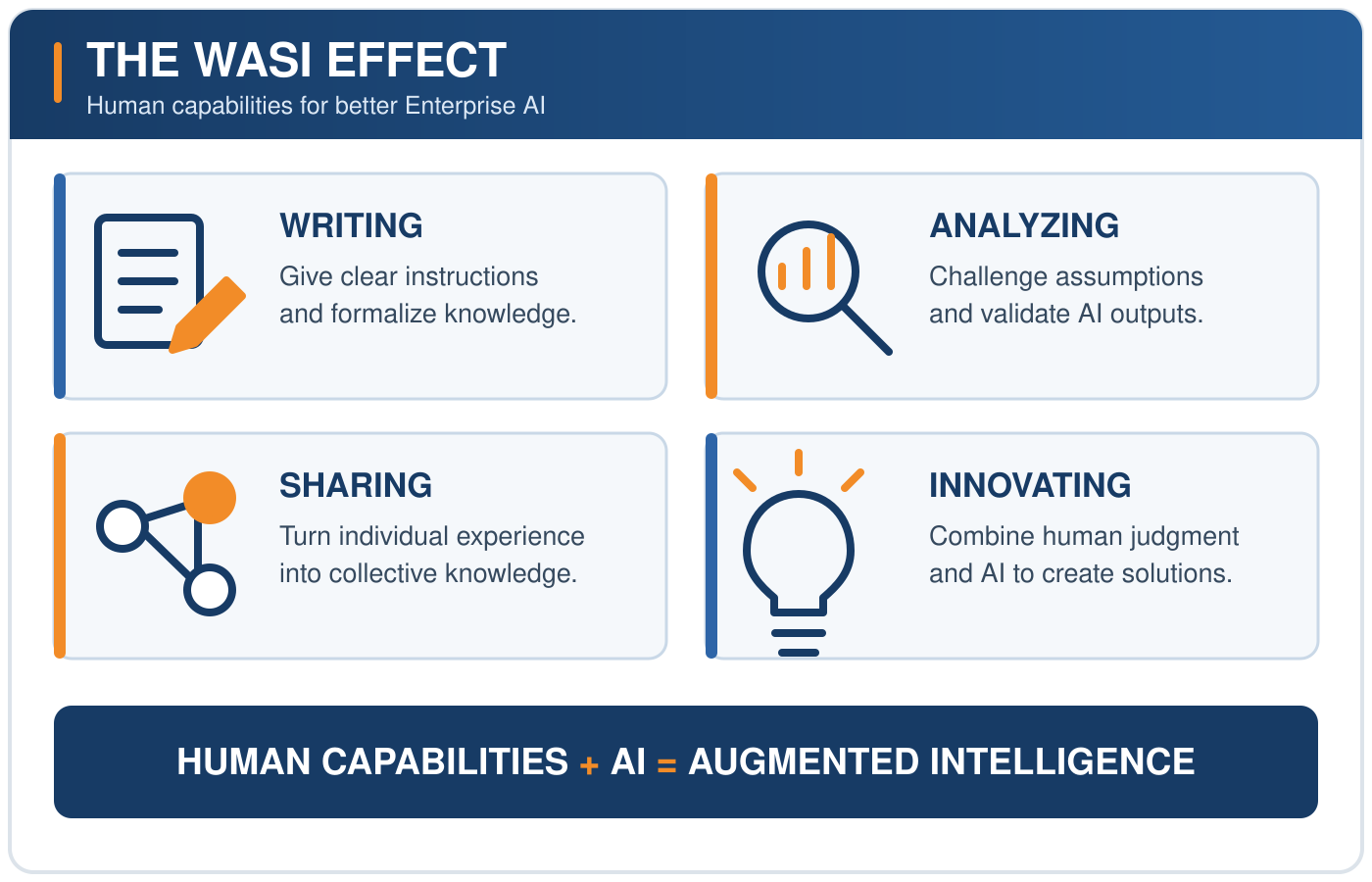
AI does not reduce the need for human capabilities. It increases it. In an AI-enabled enterprise, employees must write clearly, analyze critically, share knowledge, and innovate continuously. These four capabilities form the WASI effect: Writing, Analyzing, Sharing, and Innovating. Writing provides AI with clear instructions and reusable knowledge. Analyzing helps people challenge assumptions and validate AI outputs. Sharing transforms individual experience into collective knowledge. Innovating combines human judgment with AI capabilities to create better solutions. AI can accelerate research, synthesis, and production, but humans remain responsible for framing problems, providing context, and validating results.
Knowledge management reinforces this human–AI feedback loop by capturing relevant tacit knowledge and formalizing it as governed, reusable enterprise knowledge. The stronger the WASI capabilities, the more effectively people and AI can work togetherand the more reliable and valuable Enterprise AI systems become.
From Tacit Knowledge to Continuous Improvement
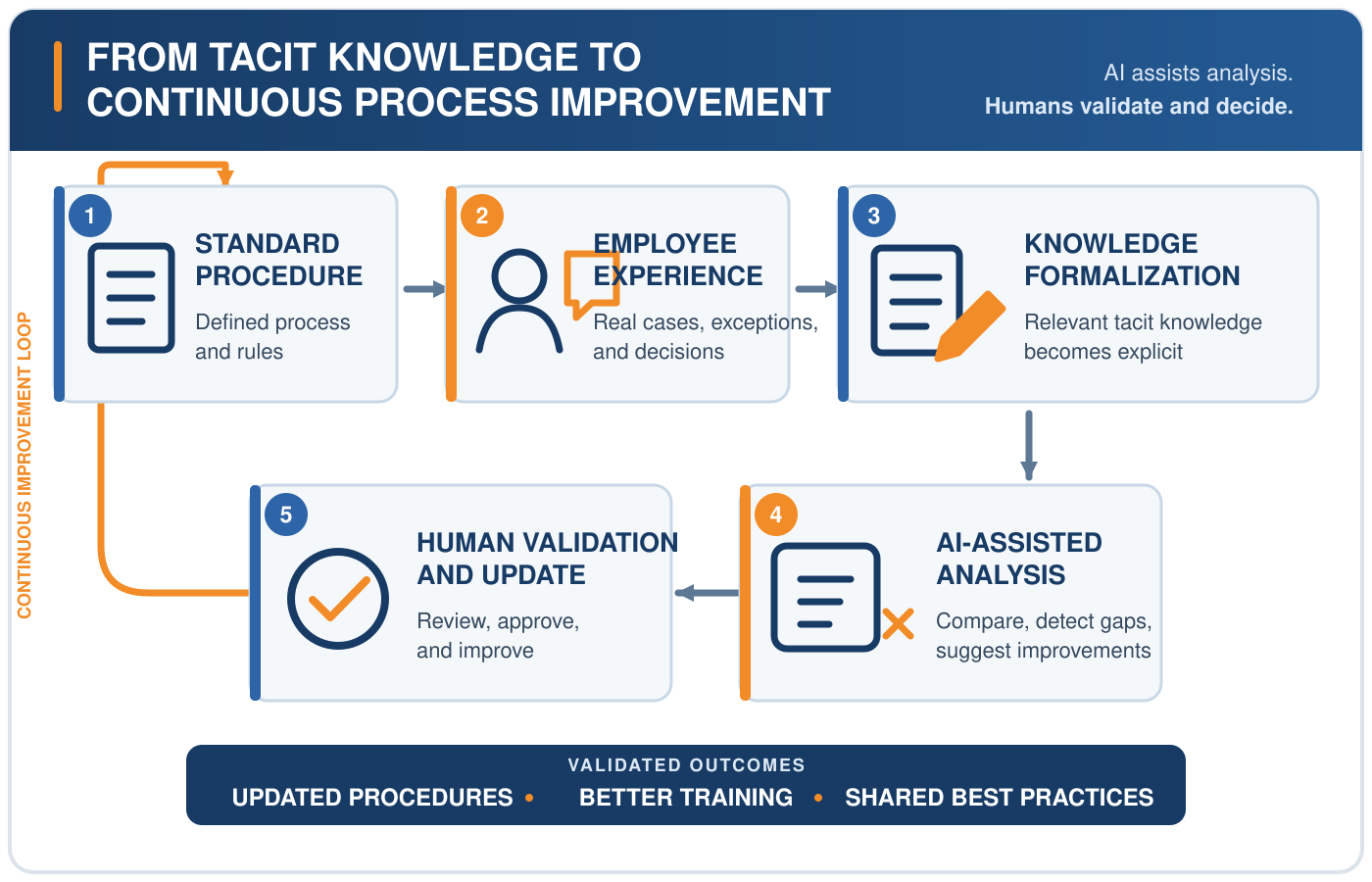
In this example, employees enrich a standard bank complaint procedure with practical knowledge gained from real cases. They explain how the procedure is actually applied, identify exceptions, and document the decisions required in different situations. This transforms relevant tacit knowledge into explicit, reusable knowledge. The AI system compares the standard procedure with this operational knowledge to identify gaps, inconsistencies, and opportunities for improvement. Human experts then review the recommendations and decide which changes should be applied.
The validated results can be used to update procedures, improve training materials, and share better practices across teams. Repeating this cycle regularly creates a continuous improvement loop. AI makes the growing body of knowledge easier to analyze and reuse, while humans remain responsible for validating recommendations and approving changes.
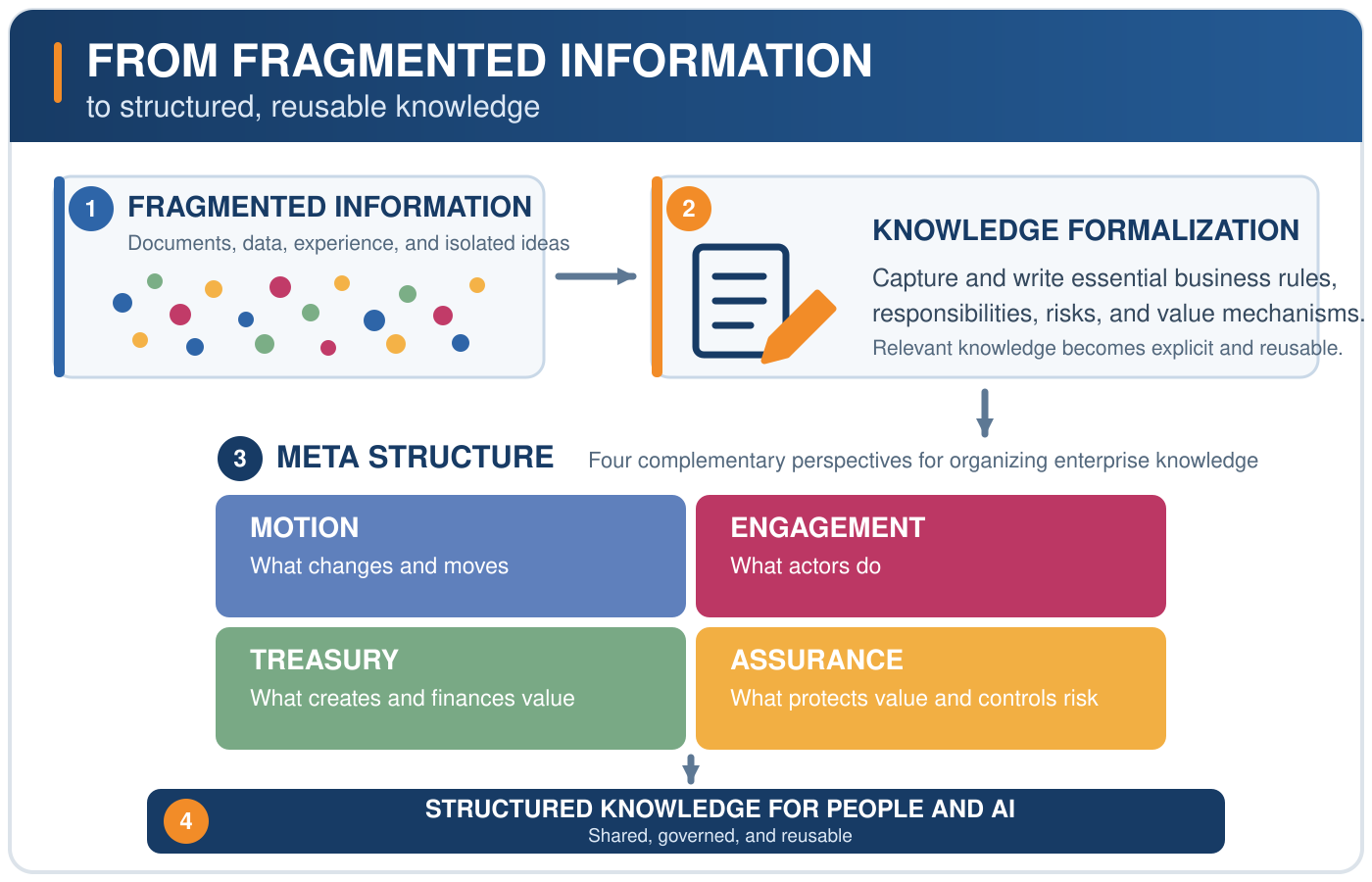
Processing Fragmented Knowledge
Access to large volumes of information does not automatically create knowledge. When information remains fragmented and poorly documented, it is difficult to understand, govern, share, and reuse.
The META model provides a simple way to organize this knowledge through four complementary perspectives: Motion, Engagement, Treasury, and Assurance. These perspectives help organizations formalize essential business rules, responsibilities, risks, and value mechanisms in writing.
Structured knowledge can then be shared across teams and made available to AI systems. Combined with clear instructions and human validation, it improves the relevance, consistency, and control of AI outputs.
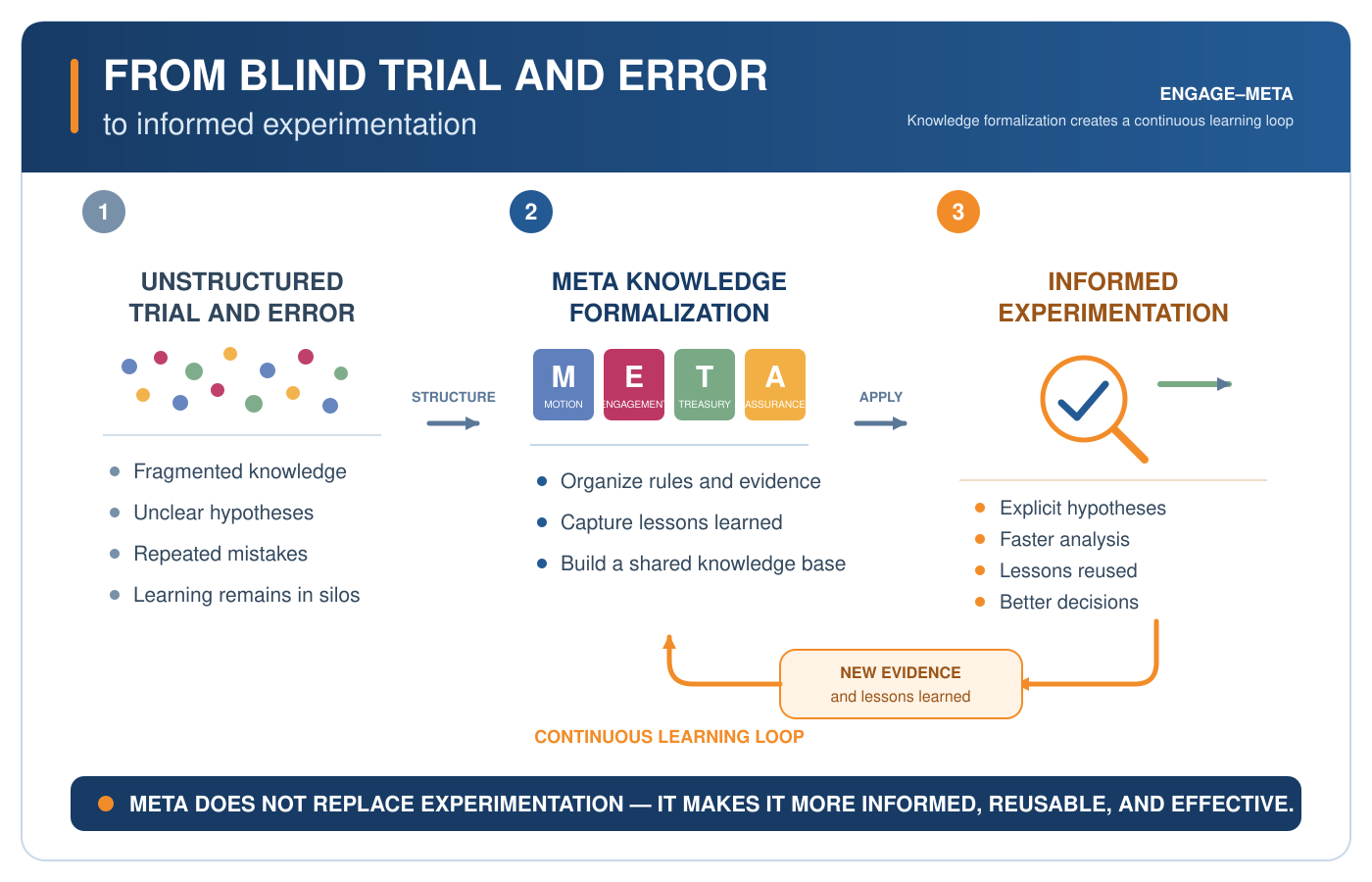
Attitude at Work
The META model does not eliminate experimentation. It reduces blind trial and error by providing individuals and organizations with a structured knowledge base before they act. Existing rules, evidence, and lessons learned are organized across the four META perspectives: Motion, Engagement, Treasury, and Assurance. This shared foundation makes analysis faster, clarifies hypotheses, and supports more informed decisions. Actions and experiments still generate new evidence. Their results are reviewed, formalized, and added back to the knowledge base, creating a continuous learning loop. This combination of knowledge and experimentation reduces repeated mistakes, improves collaboration across teams, and increases the likelihood of successful innovation.
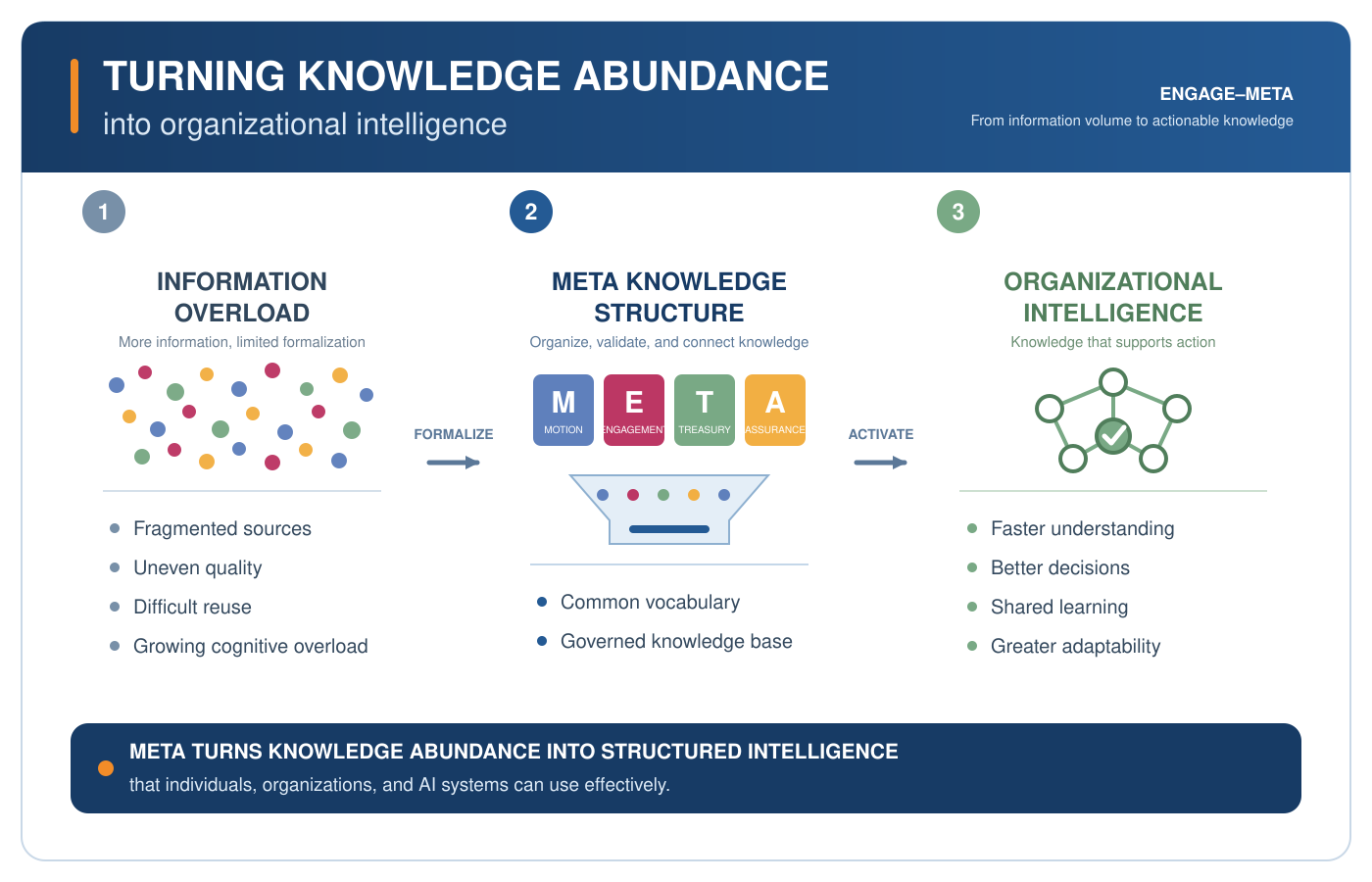
Turning Knowledge Abundance into Intelligence
Digitalization, big data, and AI are creating an unprecedented abundance of information. However, greater volume does not automatically lead to better knowledge. Organizations must structure, validate, and share this information to turn it into actionable intelligence.
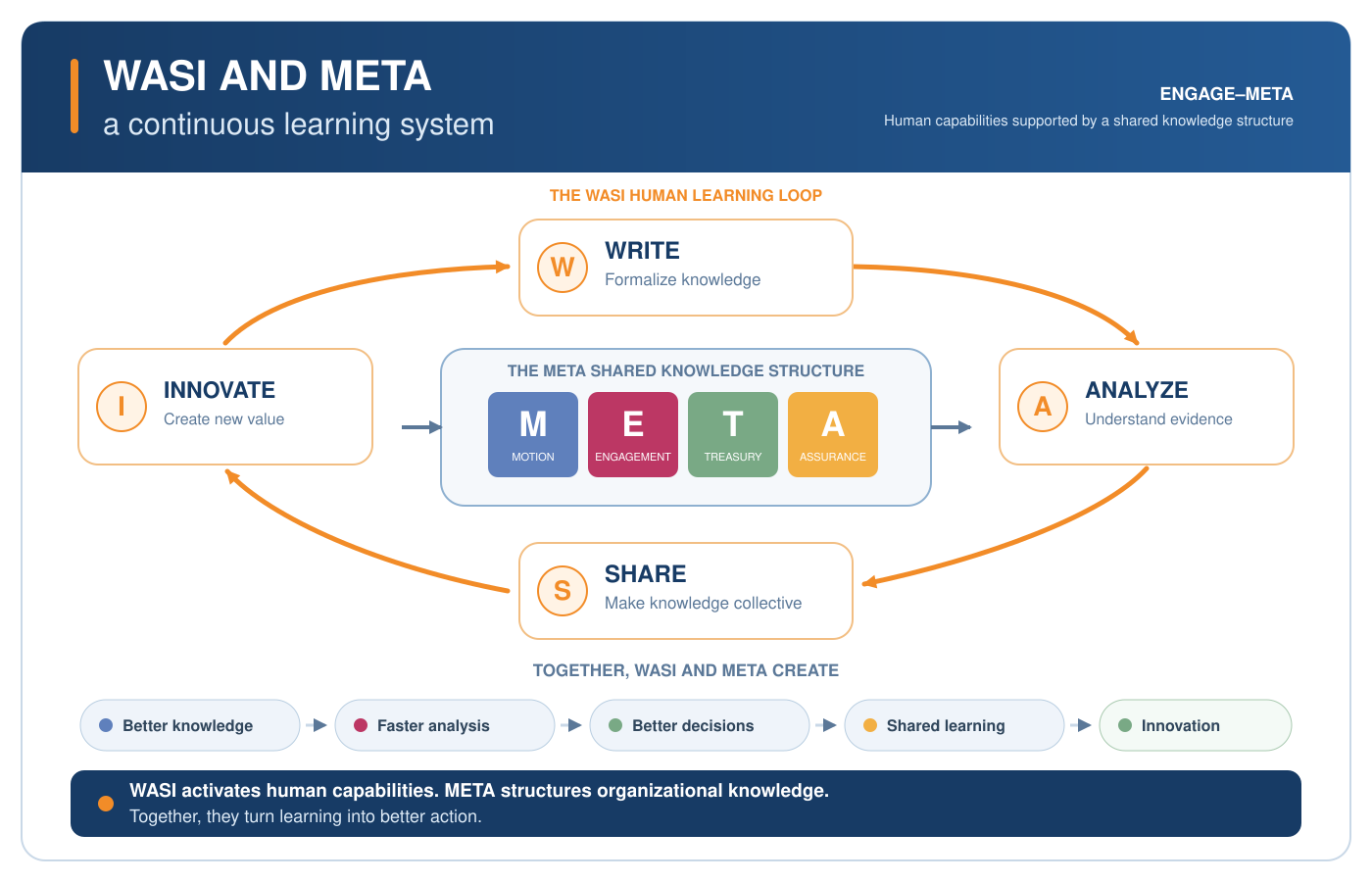
WASI and META: A Continuous Learning System
To turn structured knowledge into better action, individuals and organizations need four complementary capabilities: Write to formalize knowledge, Analyze to understand it, Share to make it collective, and Innovate to create new value. Together, these capabilities form the WASI learning loop. WASI provides the human behaviors, while META provides the shared knowledge structure. Working together, they create a continuous learning system in which knowledge is formalized, analyzed, applied, shared, and enriched over time.