Building the Enterprise Information Foundations for AI
Engage-Meta is an open knowledge initiative dedicated to helping organisations build reliable Enterprise AI through better business knowledge, Enterprise Architecture and semantic information design. It combines an educational foundation with an architectural framework for Enterprise AI and Data transformation.
The Engage-Meta Framework provides the architectural concepts and common language for practitioners and enterprise teams engaged in Enterprise AI and data transformation programs. Through the Engage-Meta Reference Vocabulary, it establishes a shared semantic foundation for designing Enterprise AI systems.
The TRAIDA Framework (Transformative AI and Data Solutions) is an educational knowledge corpus introducing the fundamentals of Enterprise Architecture, information systems, Data and AI. It is designed primarily for teams and practitioners who want to build the foundational knowledge required to understand AI and Data .
Our publications are open content under the Creative Commons Attribution 4.0 International (CC BY 4.0) license. You are free to share, reuse and adapt them, including for commercial purposes, provided that you credit the source as “Pierre Bonnet – Engage-Meta“. (See the Legal Notice for full licensing details).
Offer Presentation
Our Advisory offer follows a progressive three-step approach: explore your key AI & Data questions through a Quick Deep Dive, evaluate your current approach against the Engage-Meta Framework through a structured Benchmark, and provide ongoing Advisory support for critical decisions and execution.
This presentation provides a general technical overview of the Engage-Meta Initiative, from enterprise knowledge foundations and semantic architecture to AI reasoning and human–agent collaboration. It introduces the architectural concepts and practical principles for building reliable Enterprise AI systems at scale.
Pierre Bonnet AI & Data Consultant | Founder of Engage-Meta
With more than 30 years of international experience in software engineering, enterprise architecture and data management, I advise executive and technical teams on the design of sustainable Enterprise AI systems. After co-founding Orchestra Networks and contributing to its international growth before its acquisition by TIBCO Software, I now focus on helping organizations build the architectural, data and knowledge foundations required for Enterprise AI. Download Executive Resume (PDF).
Understand the Engage-Meta Framework in Five Minutes
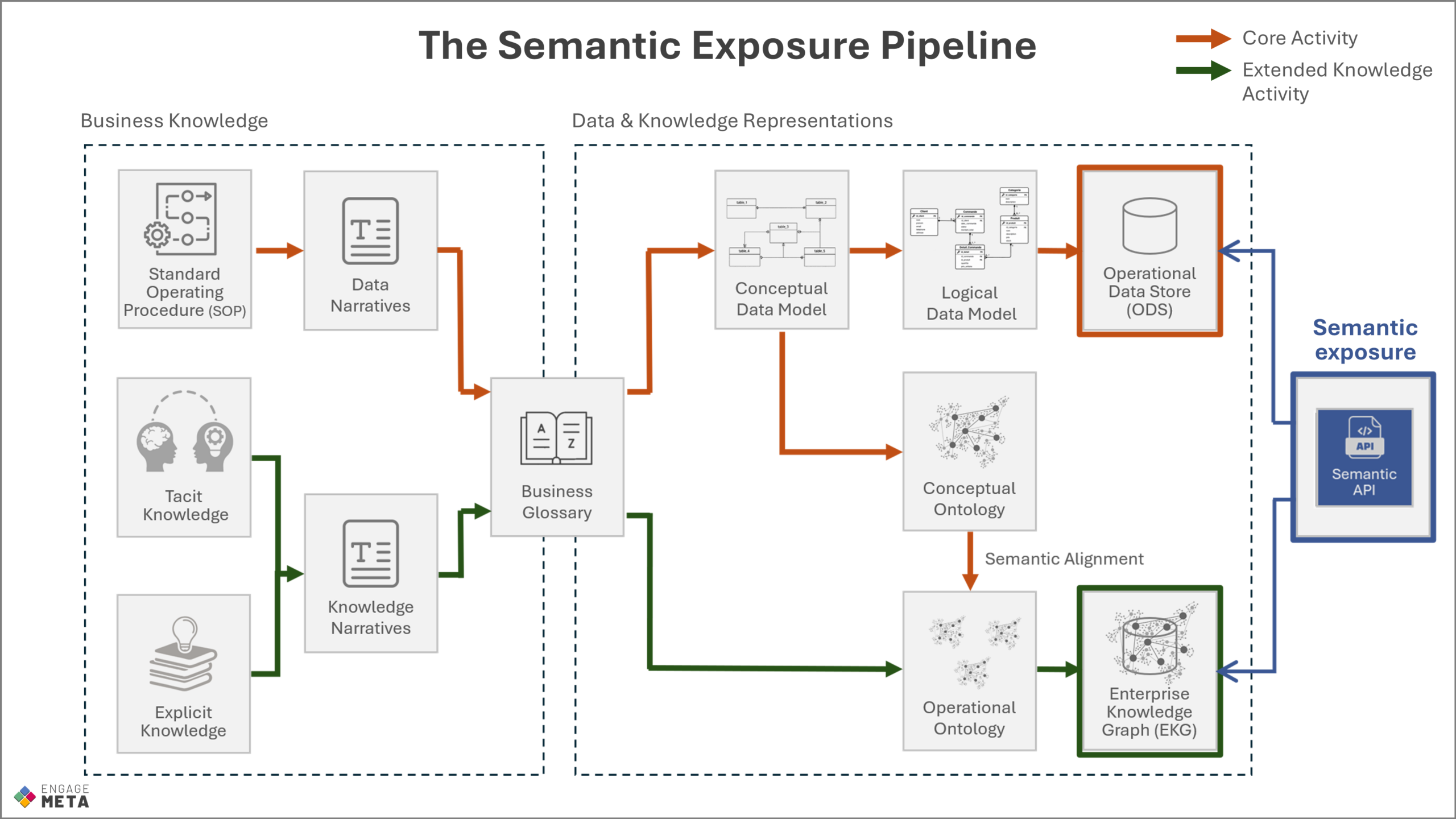
The Engage-Meta framework brings together complementary disciplines that all contribute to one strategic objective: building robust Semantic APIs. Business Narratives, Business Glossaries, Data Models, Ontologies, Operational Data Stores, and Enterprise Knowledge Graph are not independent deliverables. Together, they progressively transform enterprise knowledge into AI-understandable assets. Semantic APIs become the stable business interface between enterprise knowledge and AI systems, reducing semantic ambiguity, improving interoperability, and enabling sustainable Enterprise AI architectures.
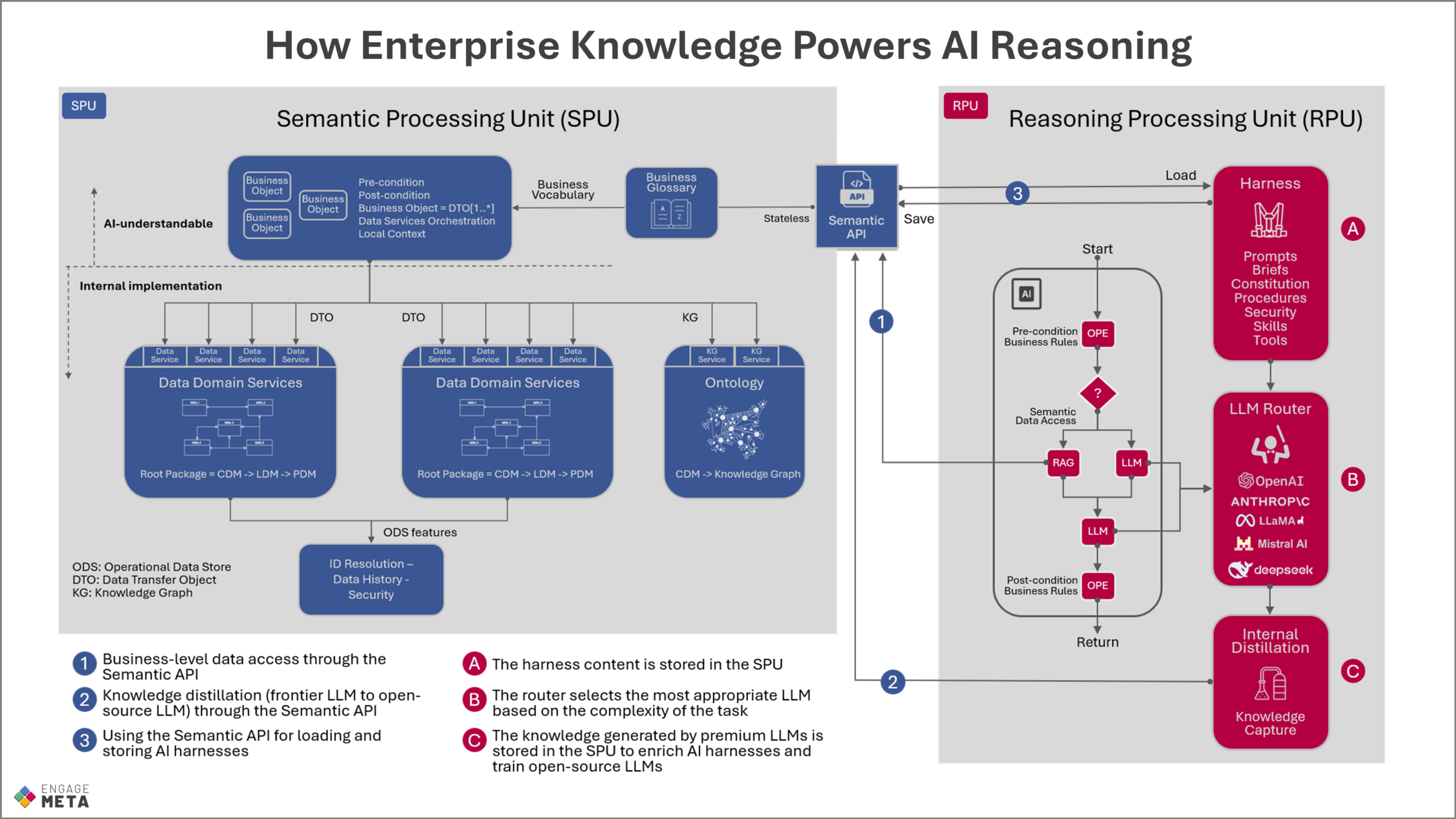
The Engage-Meta framework provides a conceptual architecture for both enterprise knowledge modeling and AI reasoning. The Semantic Processing Unit (SPU) models, organizes, and governs enterprise knowledge, while the Reasoning Processing Unit (RPU) orchestrates AI reasoning, prompts, skills, tools, and LLMs to execute business decisions. Semantic APIs form the integration layer between the SPU and the RPU, enabling AI systems to access enterprise knowledge through stable business semantics rather than technical data structures. This separation allows enterprise knowledge to evolve independently from AI technologies.
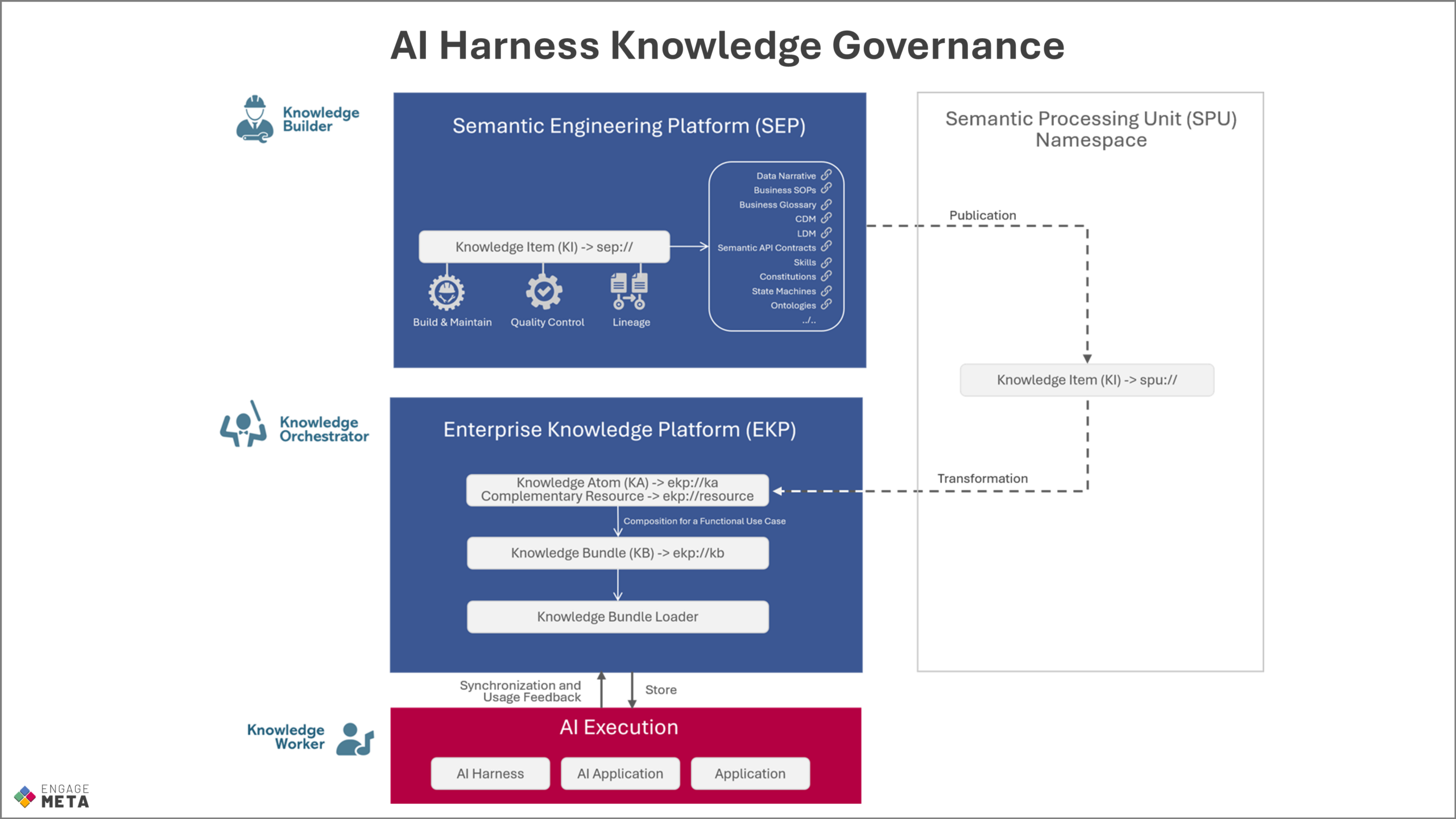
Engage-Meta separates knowledge engineering from knowledge consumption by AI. The Semantic Engineering Platform (SEP) builds, maintains, controls, and governs enterprise Knowledge Items (KI) in their native formats. Once published into the Semantic Processing Unit (SPU), the Enterprise Knowledge Platform (EKP) projects governed Knowledge Items into AI-ready Knowledge Atoms (KA) and assembles them into Knowledge Bundles (KB) according to functional use cases. These bundles can then be loaded into AI Harnesses and applications, creating a governed path from enterprise knowledge to AI execution.
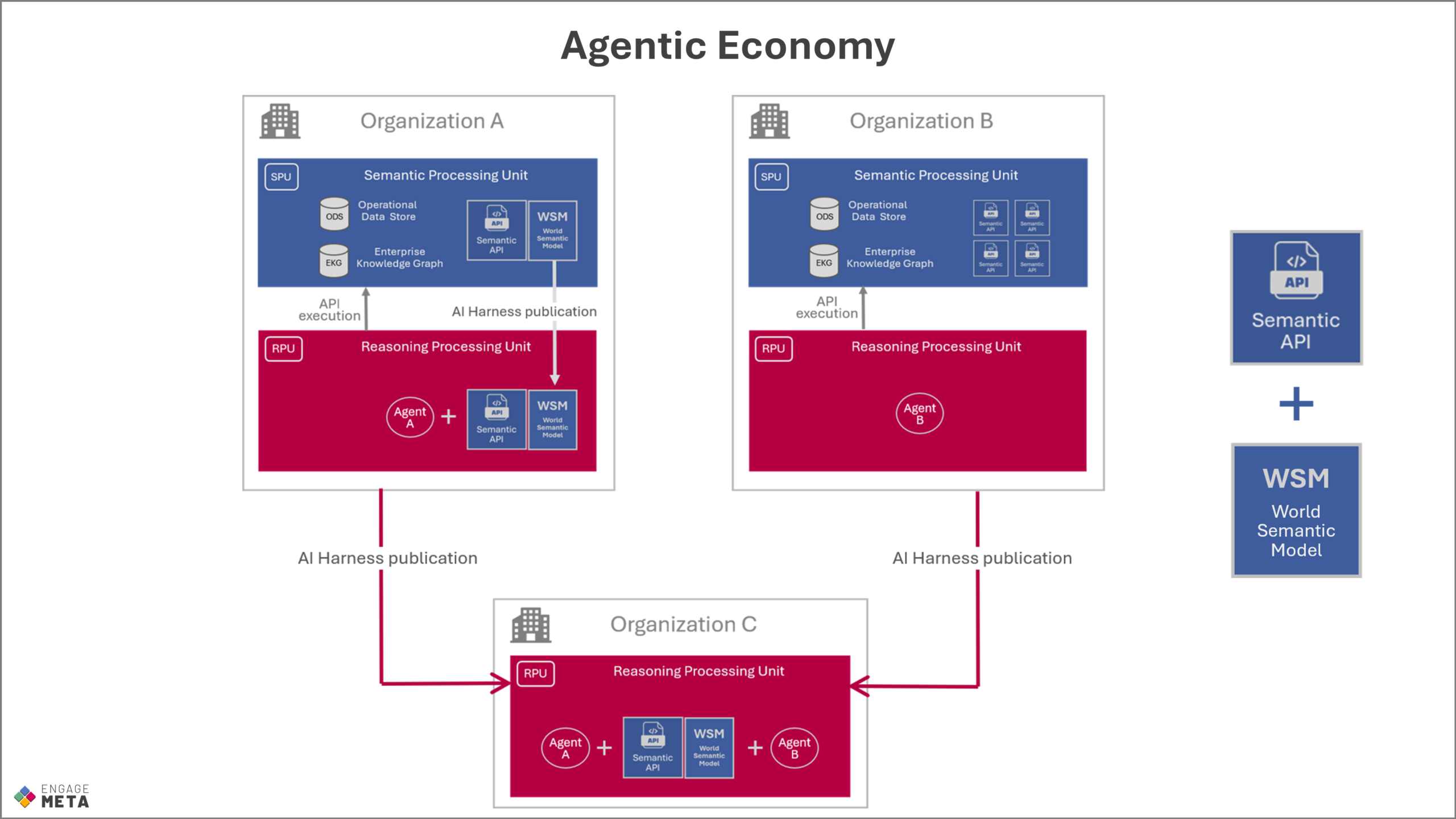
The Agentic Economy extends enterprise AI beyond organizational boundaries. Each organization can expose governed business capabilities through Semantic APIs and publish AI Harnesses that encapsulate the knowledge required for their execution. Combined with a shared World Semantic Model (WSM),these mechanisms enable agents from different organizations to understand shared business semantics, access governed knowledge and capabilities, and execute operations across enterprise boundaries. Engage-Meta therefore provides the semantic foundation for interoperable agent-to-agent business ecosystems.
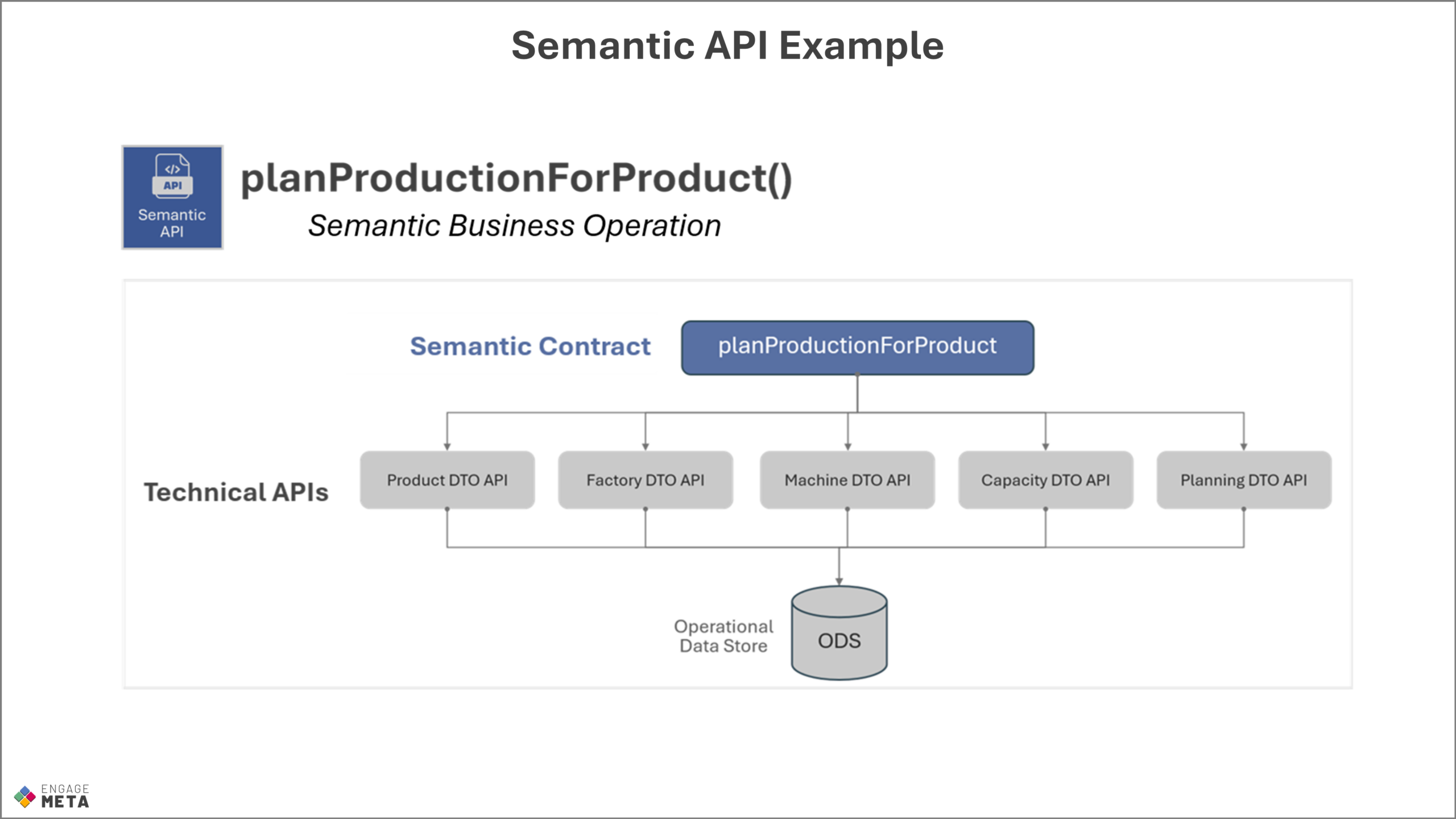
Semantic APIs expose business operations rather than application-specific data structures. Their service contracts use a logical naming convention derived from the Business Glossary, providing stable business semantics for both enterprise systems and AI agents. REST endpoints, DTOs, and other technical APIs remain implementation mechanisms behind this semantic contract.
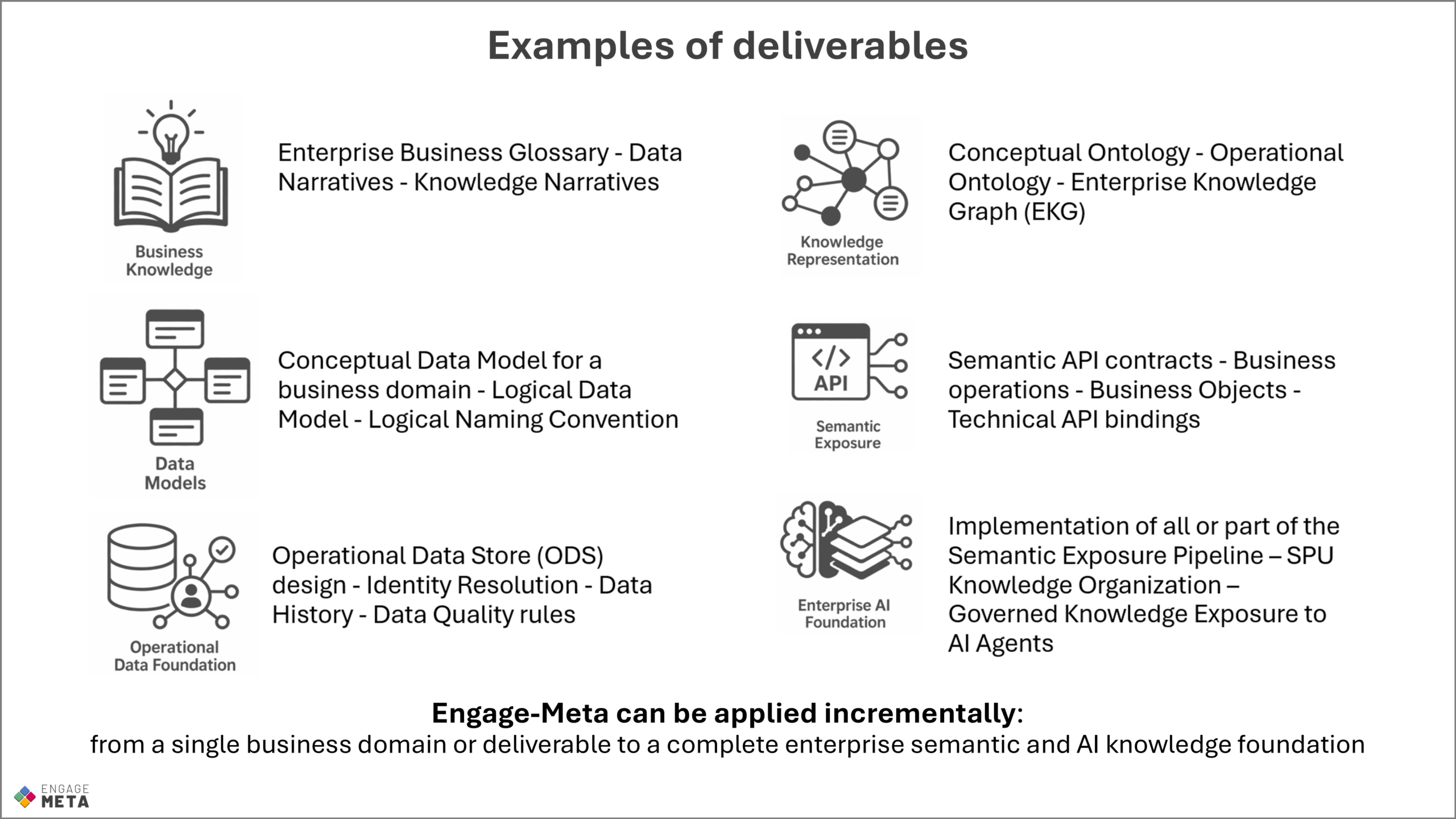
Engage-Meta can be adopted incrementally according to enterprise priorities. Deliverables can range from a Business Glossary, Data or Knowledge Narratives, and domain data models to an ODS, ontologies, Semantic APIs, an Enterprise Knowledge Graph, or the implementation of a complete Semantic Exposure Pipeline.
A Reference Vocabulary for Designing Enterprise AI Systems
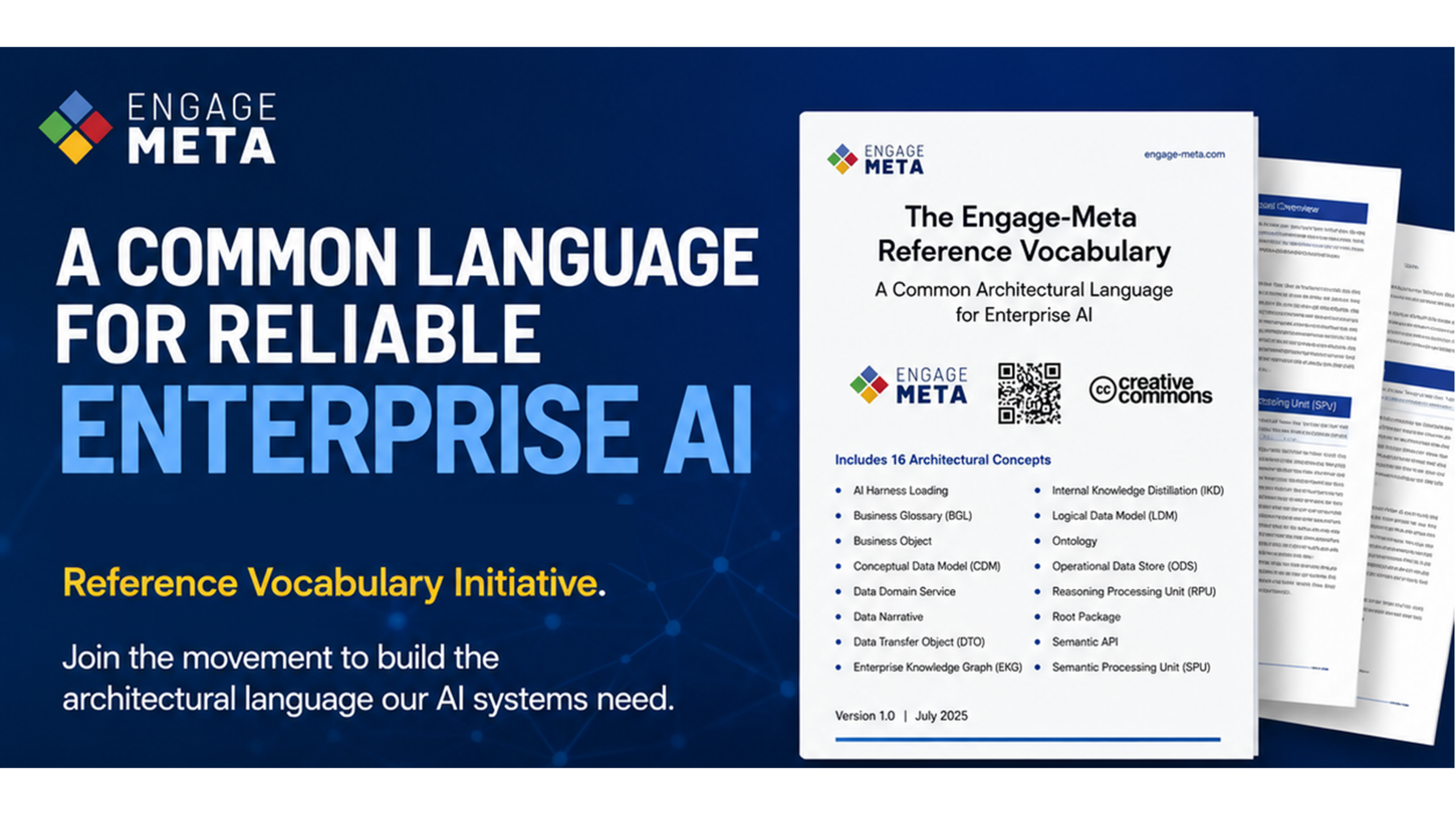
The Engage-Meta Reference Vocabulary defines the reference terminology used within the Engage-Meta Conceptual Framework. It provides a common architectural language for designing reliable Enterprise AI systems.
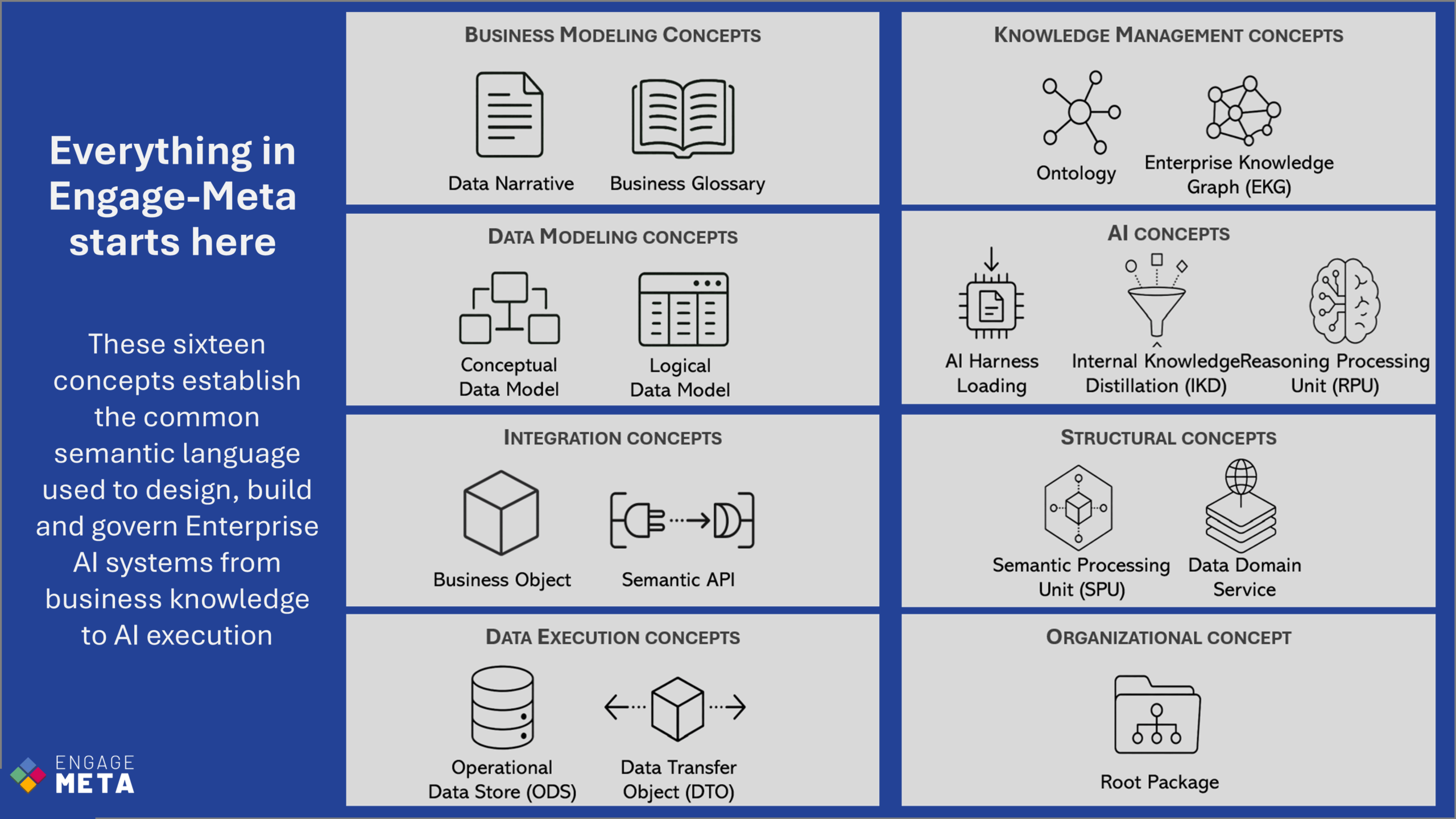
It defines sixteen architectural concepts that collectively describe the semantic architecture required to design Enterprise AI systems. The document covers business modeling, data modeling, knowledge management, operational data architecture, and AI reasoning within a single coherent vocabulary. This edition is intended to serve as the reference document for future Engage-Meta publications, guides, and architectural specifications.
Founding Supporters: Professionals from around the world have joined the Engage-Meta Reference Vocabulary Initiative as Founding Supporters, helping to promote a shared architectural language for Enterprise AI. Together, they advance the initiative’s objective of developing a common vocabulary and encouraging the adoption of better data and AI practices. We sincerely thank the following professionals for becoming Founding Supporters of the initiative.
The initiative is open to architects, engineers, consultants, researchers, managers and technology leaders worldwide. If you share this vision, I invite you to send me a direct message on LinkedIn and join the community supporting the objectives of the Engage-Meta Reference Vocabulary Initiative. Together, we can help establish a common architectural language for the next generation of Enterprise AI systems.
Founding Supporters support the objectives of the initiative in their personal capacity. Their participation does not imply endorsement of every concept or publication produced by Engage-Meta and does not represent the views of their employers or organizations. Participation is voluntary and may be withdrawn at any time upon request.
Practical White Papers
More than a traditional newsletter, each edition is a practical white paper documenting one operational aspect of the Engage-Meta framework. Together, these publications progressively build the complete methodology for designing Enterprise AI systems from business semantics and data modeling to Semantic APIs, enterprise knowledge management, and AI reasoning. This collection forms the core knowledge corpus of the Engage-Meta approach and can be read either sequentially or independently according to your interests.
Our LinkedIn newsletter is written for Architects, Data Leaders and Decision-Makers who want AI systems that actually work in production; not endless POCs, not demos disconnected from business reality. Subscription is handled directly on LinkedIn – Published monthly · Free · Expert-level AI & Data.
1. Why AI needs Semantics
2. Conceptual Framework for AI
3. Business Glossary
4. Conceptual Data Model
5. Logical Data Model & Semantic API
6. Knowledge Graphs & Ontologies
7. Equation For AI Profitability
8. Putting It All Together
9. Agentic Economy
10. Governing AI Harnesses
Explore the Engage-Meta Framework
General Overview
Understand the foundations of the Engage-Meta framework in 6 minutes.
Most AI initiatives fail not because of technology, but because business meaning is unclear.
The Engage-Meta framework introduces a structured approach to building sustainable AI systems by engineering meaning before automation.
Watch this short presentation to discover how Business Glossaries, Conceptual Data Models, and AI Agents can create reliable and scalable enterprise AI.
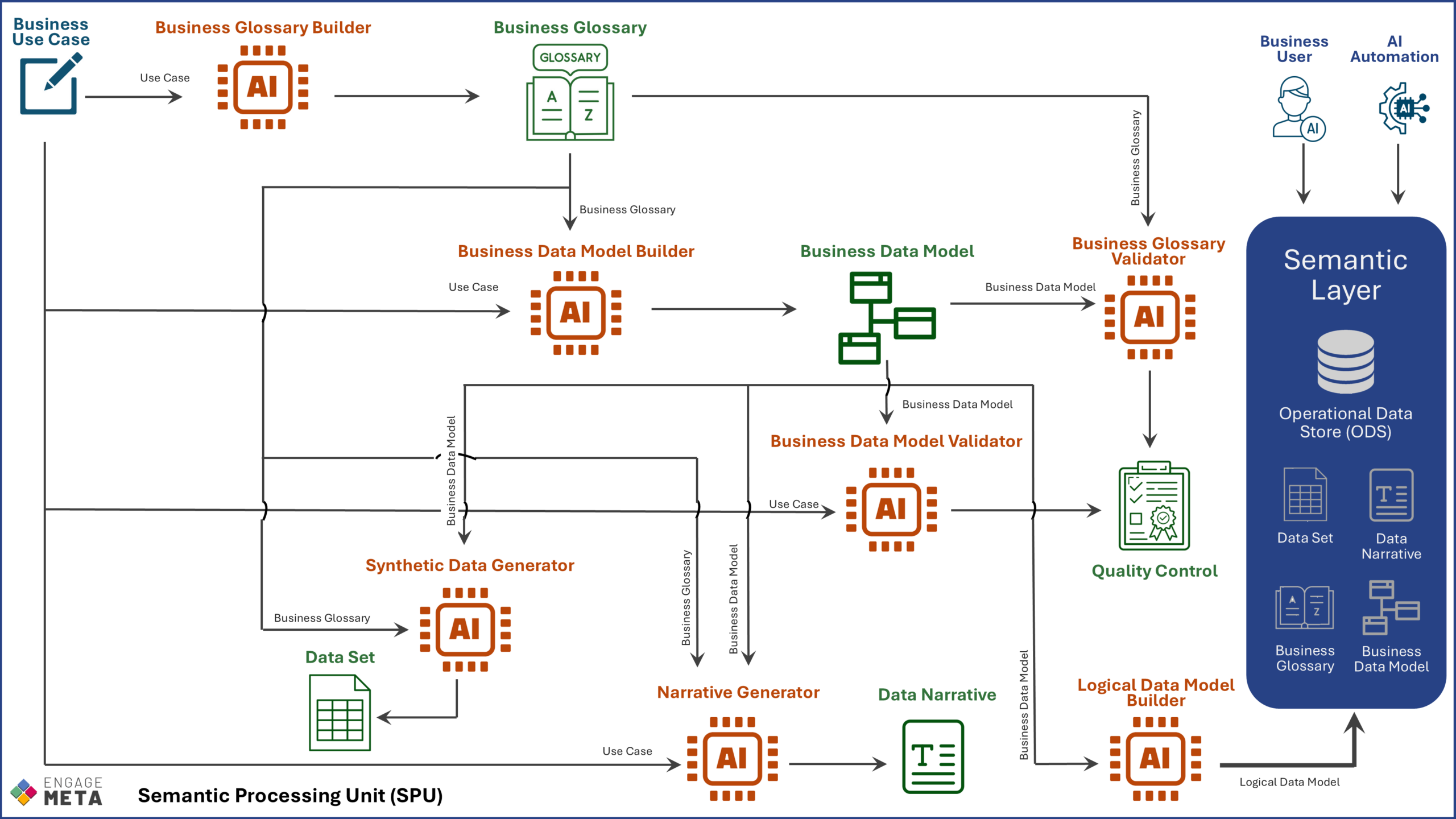
The Semantic Processing Unit (SPU) provides a structured method for building the Semantic Layer required by Enterprise AI. It combines business knowledge, conceptual data modeling and specialized AI assistants to progressively transform business intent into validated, AI-ready semantic assets. The AI Assistants automate a significant part of this modeling process, from Business Glossary and Business Data Model creation to validation, synthetic data, narratives and Logical Data Models, while keeping human expertise at the center of validation and governance.
Explore the method, download the deck and access the open-source AI Assistant instructions below.
The Semantic Processing Unit (SPU) Architecture shows how specialized AI assistants function as compute units within a semantic microprocessor. Business intent is compiled into a validated Business Glossary and Business Data Model forming the core Semantic Layer. The SPU outputs executable logical models and a persistent semantic database, enabling AI-ready enterprise data at scale.
By using the SPU, you can reduce your Semantic Layer modeling budget and timeline tenfold for your operational data (ODS, MDM) and knowledge-graph ontologies (RDF-OWL). This is made possible by the power of AI, acting as an experienced modeling consultant, combined with the TRAIDA AI Assistants published by Engage-Meta. These Assistants encapsulate our expertise and give it to you for free to: write the business glossary, create taxonomies, model the business-level entity-relationship diagram, and finally, build RDF-OWL ontologies. AI does 70% of the work for you! The rest is your intelligence to refine, validate, share, and implement within your organization.
Conceptual Data Modeling (Training)
This training introduces the key principles of Conceptual Data Modeling for profitable AI systems. It explains why it is the cornerstone for deploying Artificial Intelligence at scale. By structuring data around business concepts, organizations can move beyond fragmented data, spreadsheets and inconsistent definitions, building a solid foundation for enterprise knowledge, advanced analytics, and AI-driven automation.
Our publications are open-source (Creative Commons) and free to use. You can reuse and enrich them in your own commercial and educational activities, provided that you cite the source: engage-meta.com.